
Pilot Coaching
Series 2026/27
Four focused coaching workshops for licensed pilots who want to develop their thermalling, cross-country, competition and adventure-flying skills — structured theory, practical coaching, decision-making, safety and post-flight analysis.
Why keep developing after your licence?
A licence is a foundation, not the end of pilot development. Most pilots settle into routine site flying and stop being deliberately coached — and progress slows.
Thermalling, cross-country, competition and adventure flying each expose you to different air, different decisions and different risks. Developing across them builds broader capability, better judgement and more independence.
These workshops are structured coaching, not lectures. Each one combines theory and preparation with real flying, decision-making, safety and honest post-flight analysis — turning airtime into deliberate learning.
The series
Four standalone workshops
Thermal Flying → Cross-Country Flying → Competition Flying → Adventure Flying. Book any one on its own — earlier workshops are not a prerequisite for later ones.
Thermal Flying
Predict, find and use thermals — and build real skill for active air.
Move from waiting for smooth conditions to reading and working active air with intent — thermal prediction, identification, technique, strategy and safety.
Theory
Thursday 15 October 2026
Practical
Saturday 17 October 2026
Backup: 18 October
Cross-Country Flying
Turn thermalling and site-flying skills into deliberate journeys.
The complete lifecycle of an XC day — weather, route and equipment preparation, in-flight decisions, outlanding, retrieve and analysis. Not simply a long flight.
Theory
Thursday 12 November 2026
Practical
Saturday 14 November 2026
Backup: 15 November
Competition Flying
Use a structured task environment to sharpen planning, navigation and decision-making.
How competitions work, how tasks are set and flown, and a mock competition task on the practical day. Useful whether or not competition results matter to you.
Theory
Thursday 3 December 2026
Practical
Saturday 5 December 2026
Backup: 6 December
Adventure Flying — Hike & Fly / Vol-Biv
Use the paraglider as a tool for mountain travel — and understand the extra skills and risks.
Planning, equipment trade-offs, loaded flying, and launch and landing skills for hike-and-fly and vol-biv. The practical is packing and flying as though on an adventure — not a vol-biv expedition.
Theory
Thursday 28 January 2027
Practical
Saturday 30 January 2027
Backup: 31 January
How each workshop works
Thursday evening
A focused theory and coaching session — the knowledge, planning, decision-making, safety and mental aspects behind the practical.
Saturday, Sunday backup
A practical coaching day applying the workshop concepts in real flying, planned for Saturday with Sunday held as a same-weekend weather backup.
Location
Chosen according to the forecast and the objective of the workshop. The flying site is deliberately not fixed in advance.
Group size
4–8 pilots. Deliberately small, so the practical coaching is meaningful.
Transport
Not included. Pilots self-drive or car-pool. Shared transport may be arranged depending on the group and destination.
Weather
The practical day is Saturday, with Sunday held as a backup if the weather or site conditions don't cooperate. If neither day is flyable, the session still runs as a non-flying practical rather than an open-ended reschedule.
The workshops do not promise a particular flying site, a flight duration, an XC distance, reaching goal, a vol-biv expedition, or weather that cannot be guaranteed. The product is the coaching objective and the development opportunity — described precisely, so you know what is actually included.
A consistent coaching approach
The content changes between workshops, but the method does not. Each workshop works through the same questions:
And a recurring cycle across every practical day:
Plan → Fly → Analyse → Learn
The mental game runs through all four workshops rather than being a motivational add-on — fear, confidence, ego, comparison with other pilots, group pressure, goal fixation, fatigue and decision-making under stress. A central principle is to judge the quality of a decision by the information available at the time, not only by how the flight turned out.
OCT · Workshop 1
Thermal Flying
Predict, find and use thermals — and build real skill for active air.
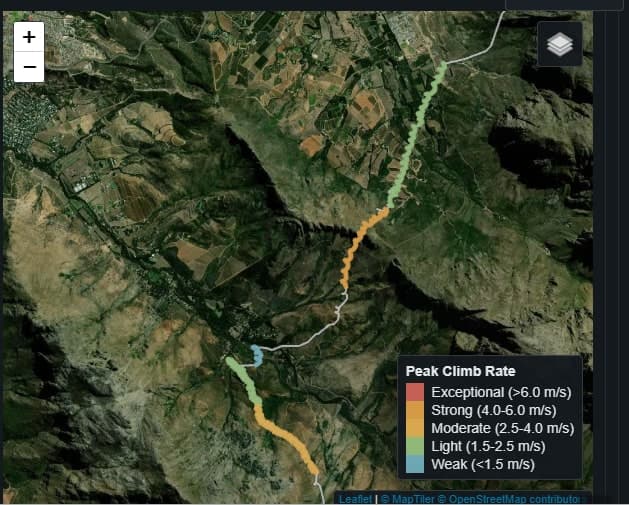
Post-flight track analysis — climb rate mapped along a real flight.
Theory
Thursday 15 October 2026
Practical
Saturday 17 October 2026
Backup: 18 October
The practical day is Saturday, with Sunday held as a backup if the weather or site conditions don't cooperate. If neither day is flyable, the session still runs as a non-flying practical rather than an open-ended reschedule.
Why do this?
Thermalling is useful even if most of your flying is ridge or coastal soaring. Thermals are active air you deliberately choose to use, and learning to work them develops active piloting, glider feedback, weather awareness, situational awareness and decision-making. Controlled experience in active air also builds handling and judgement you can draw on if you meet unexpected rough air elsewhere.
What the workshop covers
- Thermal prediction — terrain, sun and heating, wind, thermal sources, trigger points, thermal cycles, time of day, changing conditions and other clues
- Thermal identification — glider feedback, vario behaviour, changes in the surrounding air, birds, other pilots, thermal edges and drift
- Thermal technique — entry, turn direction, establishing a consistent turn, centring, adjusting the circle, responding to a moving core, bank and airspeed control
- Thermalling strategy — when to accept weak lift, when to search, when to stay, when to leave, how high to climb, and how this changes when low versus high
- Thermalling safety — traffic, right-of-way and turn direction, terrain clearance, wind and thermal drift, cloud considerations, and recognising conditions beyond your current ability
- The mental game — fear of active air, overreacting to glider movement, frustration after losing a thermal, and following other pilots instead of interpreting your own information
The practical day
Predict → Find → Identify → Centre → Climb → Decide
A weather-dependent coaching day that connects directly to the Thursday session. Before launch you are asked where you expect lift and why; during and after the flight the coaching compares your prediction with what actually happened. The objective is to apply the thermal-flying process in suitable conditions — not a guaranteed height gain or flight duration.
What you can expect to develop
A working expectation of where lift should be before you fly into it, faster and clearer reading of lift once you are near it, a more consistent and better-centred climb, deliberate decisions about when to stay, leave or search, and post-flight analysis habits you can keep using.
Thermal flying does not make hazardous rotor or mechanical turbulence safe. The point is that controlled experience in active air develops relevant handling, awareness and judgement.
NOV · Workshop 2
Cross-Country Flying
Turn thermalling and site-flying skills into deliberate journeys.
Theory
Thursday 12 November 2026
Practical
Saturday 14 November 2026
Backup: 15 November
The practical day is Saturday, with Sunday held as a backup if the weather or site conditions don't cooperate. If neither day is flyable, the session still runs as a non-flying practical rather than an open-ended reschedule.
Why do this?
Cross-country flying teaches you to use your thermal and general flying skills to deliberately go somewhere. It develops independent decision-making, weather awareness, route planning, terrain and situational awareness, navigation, logistics, risk management and self-reliance. The workshop covers the whole XC day, not just the flight.
What the workshop covers
- Preparation — flying equipment, instrument setup, navigation, apps and maps, live tracking, communication, power and battery management, water, food, what to carry for an outlanding, and retrieve preparation
- Weather and route planning — appropriate forecasts, wind at different altitudes, expected thermal strength and depth, timing of the day, route and terrain, landing options, airspace, hazards, decision points and backup plans
- Starting the day — arriving early, getting to takeoff early, observing the site, watching thermal cycles develop, and launching as early as the day reasonably allows
- Flying the XC — when to stay in or leave a thermal, glide decisions, selecting the next likely source, staying high versus calculated risk, decisions when getting low, landing-option awareness, and making independent decisions rather than following other pilots
- Safety — unfamiliar terrain, stronger or changing conditions, decision-making under pressure, fatigue, dehydration, communication, tracking, landing alone, and recognising when to stop pursuing the goal
- Landing, retrieve and etiquette — choosing an outlanding, packing, sharing location, private property, gates, crops and livestock, respectful interaction with landowners, and helping other pilots
- The mental game and structured post-flight analysis
The practical day
Early meeting → Weather briefing → Route decision → Equipment / tracking check → Observe conditions → Launch → Coached XC attempt → Retrieve → Debrief
A coached XC day. Different pilots may have different appropriate goals — the coaching objective is the XC process, not a set distance. Where useful you plan a possible route on Thursday and compare it with the actual conditions on Saturday.
What you can expect to develop
A repeatable way to build a realistic route from a forecast, readiness on the ground so you solve equipment and admin problems before launch rather than in the air, better in-flight decisions about thermals, glides and getting low, outlanding and retrieve judgement, and a structured post-flight debrief.
The practical day does not promise a particular distance or that you will reach a goal. Success depends on the quality of the planning, decisions and learning.
DEC · Workshop 3
Competition Flying
Use a structured task environment to sharpen planning, navigation and decision-making.
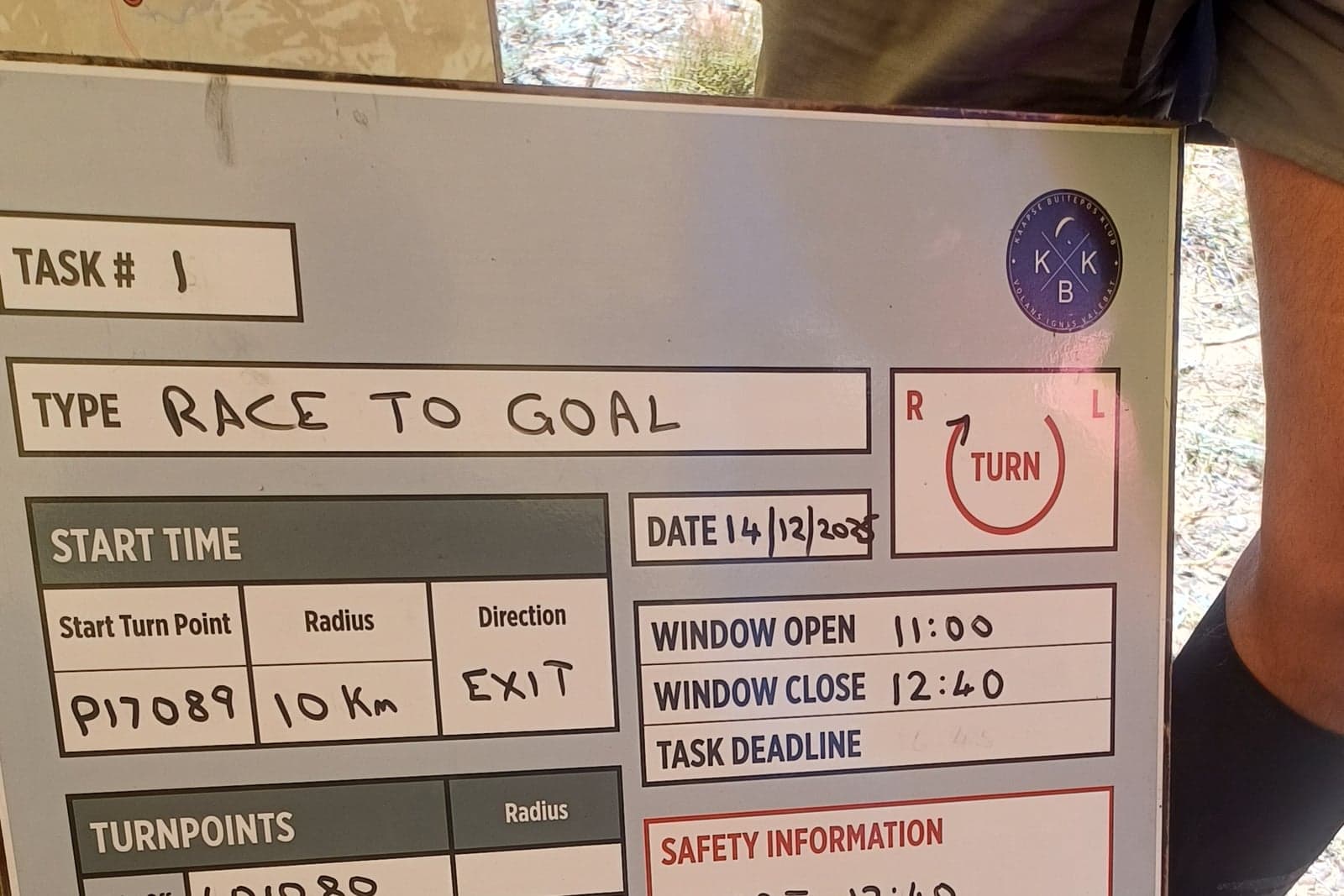
A real task board — turnpoints, start window, safety information.
Theory
Thursday 3 December 2026
Practical
Saturday 5 December 2026
Backup: 6 December
The practical day is Saturday, with Sunday held as a backup if the weather or site conditions don't cooperate. If neither day is flyable, the session still runs as a non-flying practical rather than an open-ended reschedule.
Why do this?
Competition flying is not only for pilots trying to win. It is a structured environment that can accelerate development — defined tasks, consecutive flying days, flying alongside stronger pilots, objective feedback, and the chance to see how other pilots solve the same task. It can be a structured way of becoming a better pilot without results needing to be the point.
Scheduled deliberately just before the Porterville Paragliding Open period, so pilots entering the competition can use it as preparation.
What the workshop covers
- Choosing and entering a competition — finding suitable competitions, understanding level and pilot requirements, registration, licences and documentation, insurance, entry fees and deadlines
- Planning the trip — travel, accommodation, vehicle and retrieve arrangements, budgeting, work and leave, site research and expected conditions
- Equipment and instrument preparation, waypoints, navigation setup and appropriate backup systems
- How a competition works — meet director, task committee, safety committee, scoring, pilot responsibilities, task briefings and daily structure
- How tasks are set — forecast, expected thermal window, wind, terrain, airspace, the pilot field, appropriate difficulty, turnpoints, start position and timing, goal, safety, areas to avoid and contingencies
- The competition morning routine, and understanding and entering the task — turnpoints, cylinders, start cylinders and gates, speed section, goal, the optimised route, instrument navigation and common setup errors
- Task strategy and in-flight decisions — start timing, using other pilots as information, groups versus independent decisions, when to leave climbs, speed versus altitude, and decisions when leading, behind or low
- Competition safety, the mental game, and enough scoring theory to understand what the system rewards and why you got the result you did
The workshop draws on real task-setting experience — repeated task-committee involvement at competitions including the Barberton Nationals and the Porterville Paragliding Open — to explain the reasoning behind task design, not just how to follow a task.
The practical day
Weather briefing → Task-setting discussion → Task published → Pilots load the task → Briefing → Launch / start → Fly the task → Goal / landing → Track review → Scoring / debrief
A miniature competition simulation — a mock task. You experience task setting, loading and verifying a task, the briefing, the start, flying the task, and the track review and scoring debrief afterwards, so you can experience the competition process before entering or while developing as a competition pilot.
What you can expect to develop
A clear picture of how a competition day runs, the ability to receive, load and verify a task without errors, a repeatable competition-morning routine, a strategy suited to where you actually are rather than to the lead gaggle, and the habit of separating decision quality from outcome.
The practical day does not promise that you will reach goal, and this workshop implies no official affiliation with any competition.
JAN · Workshop 4
Adventure Flying — Hike & Fly / Vol-Biv
Use the paraglider as a tool for mountain travel — and understand the extra skills and risks.
Theory
Thursday 28 January 2027
Practical
Saturday 30 January 2027
Backup: 31 January
The practical day is Saturday, with Sunday held as a backup if the weather or site conditions don't cooperate. If neither day is flyable, the session still runs as a non-flying practical rather than an open-ended reschedule.
Why do this?
Adventure flying combines paragliding with hiking, mountains, travel and exploration — access to remote terrain, fitness, self-reliance, and places that would otherwise take much longer to reach on foot. Not every hike-and-fly is a major expedition; short hikes followed by short flights are valuable experiences and good skill development.
What the workshop covers
- Hike-and-fly and vol-biv as related but distinct disciplines — vol-biv adds greater self-sufficiency, overnight equipment, route continuity, food and water planning, shelter and sleep systems, and longer-duration decision-making
- Planning — route selection, where flying is legal, launch and landing permissions, land access, airspace, conservation restrictions, escape routes, alternative launches, water, communications, transport and backup plans, and the core question: what is the plan if I cannot fly?
- Weather for a route rather than a single flying site — wind at different elevations, valley winds, thermal development, cloud, rain, changes while hiking, and when to change or abandon the plan
- Equipment and packing, and the trade-offs of lightweight gear — weight, durability, protection, comfort, handling, cost and safety margin, and the practical question: what does each additional kilogram buy me?
- Launch skills — no-wind, light-wind and strong-wind launches, assessing an unimproved launch, wing control while carrying extra equipment, abort points, and knowing when not to launch
- Landing skills — no-wind and fast landings, smaller and unfamiliar areas, landing with additional load, top-landing considerations and aborting an attempt
- Flying loaded and tired, and the mental game — fatigue, group pressure, time pressure, sunk-cost thinking, and the principle that the inconvenience of walking down should not determine whether a launch is safe
- Remoteness and safety — loss of signal, tracking, satellite communication where appropriate, sharing the plan, expected check-in, basic first aid, and how the consequences of an incident change in remote terrain
The practical day
Pack as though undertaking an adventure → move and fly with the load → compare equipment and packing → analyse the whole mission
Bring your hike-and-fly or vol-biv setup if you have one, including sleeping, shelter and other equipment where relevant. Depending on conditions the day may involve hike-and-fly, XC while loaded, a hike followed by a short flight, equipment and packing comparison, pack weighing, launch assessment, and flying and landing with the additional load. A short flight is not a failed practical day.
What you can expect to develop
A realistic planning process for a flying route rather than a site, a considered view of lightweight-equipment trade-offs, launch and landing judgement for unimproved terrain and no or light wind, and awareness of how fatigue and remoteness change your decisions.
The workshop does not promise — and the practical day is not — an actual vol-biv expedition. It is also not a wilderness survival or mountain-rescue course.
Pricing
Standard
R1750 / workshop
Licensed Pilot Programme members
R1500 / workshop
Book with a R750 deposit per workshop; the balance is settled with Ria before the workshop. Your R750 deposit is transferable to another workshop or a future date at any time, and refundable less a R200 admin fee up to 7 days before the workshop. If a workshop does not reach its minimum of 4 pilots, the deposit is refunded in full.
Book a workshop — R750 depositAlready in the AirSchool Licensed Pilot Programme? Your workshop rate is R1500.
Your coach
Ria Moothilal holds SAHPA Grade B and Grade C instructor qualifications, runs a SACAA Declared Training Organisation, and has over 2,000 paragliding flights across Cape Town and Western Cape sites over 20+ years in air sports. An engineering and data-science background sits behind the automated forecasting system used by the Cape Town flying community — and behind an analytical, honest approach to coaching.
Ria is an active competition pilot and regularly serves on competition task committees — including at the Barberton Nationals and the Porterville Paragliding Open — deciding task routes around forecast conditions, airspace, terrain, retrieve logistics and the pilot field. That experience is used to explain the reasoning behind task design, not just how to follow a task.
Frequently asked questions
Do I have to attend all four workshops?
No. Each workshop is standalone — book one, some, or all four. Attending an earlier workshop is not a prerequisite for a later one.
Where will the practical flying take place?
The site is chosen to fit the forecast and the objective of the workshop, and is deliberately not fixed in advance. Possible Western Cape sites include Porterville, Hermanus and Franschhoek, among others. The product is the coaching objective, not a trip to a particular site.
What happens if the weather is unsuitable?
The Thursday theory session runs regardless of conditions. The practical day is Saturday, with Sunday held as a backup if the weather or site conditions don't cooperate. If neither day is flyable, the session still runs as a non-flying practical rather than an open-ended reschedule.
Is transport included?
No. Transport is not included in the workshop fee. Pilots self-drive or car-pool. Shared transport may be arranged depending on participant numbers and the destination.
How many pilots are in each workshop?
Between 4 and 8. The small group is deliberate — it is what allows meaningful practical coaching.
Does the Adventure workshop include an actual vol-biv trip?
No. The practical exercise is to pack as though undertaking an adventure and experience moving and flying with the load. Depending on conditions it may involve hike-and-fly, flying loaded, or a hike followed by a short flight. It is not a vol-biv expedition, and it is not a wilderness survival course.
How do I pay?
Book online with a R750 deposit per workshop; the balance is settled with Ria before the workshop. Your R750 deposit is transferable to another workshop or a future date at any time, and refundable less a R200 admin fee up to 7 days before the workshop. If a workshop does not reach its minimum of 4 pilots, the deposit is refunded in full.
I'm in the AirSchool Licensed Pilot Programme — how do I get the member rate?
The R1500 workshop rate is a benefit for Licensed Pilot Programme members. Tick the box when you book; Ria confirms your membership and applies it to your balance.
Book a workshop
R750 deposit holds your place. Groups are capped at 8 pilots.